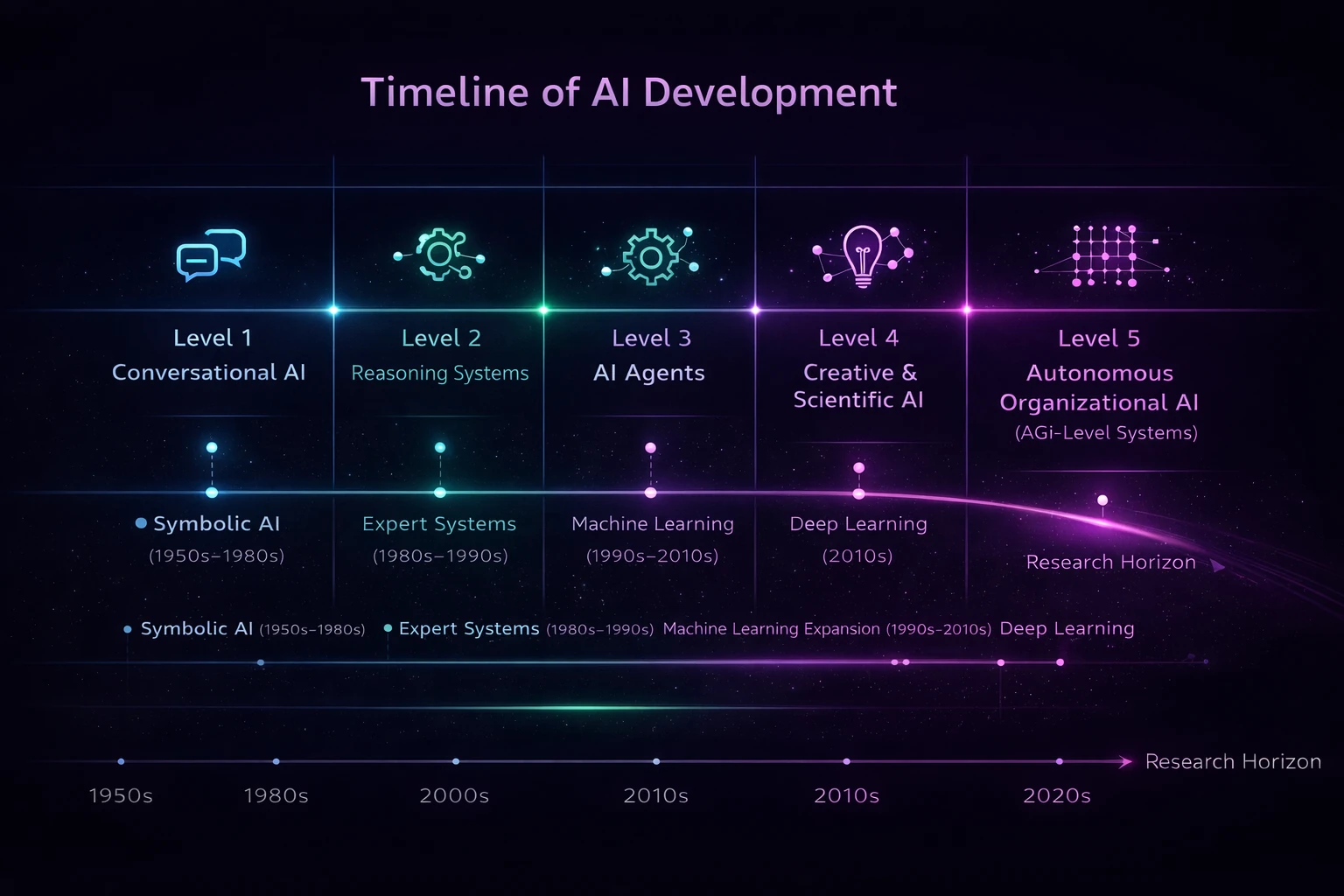
Figure: Conceptual timeline of AI development and capability levels. This framework is educational, not an official industry classification.
At this level, AI systems respond to prompts using natural language.
Examples include:
These systems can generate human-like text and answer questions, but they do not truly understand meaning. They predict likely responses based on patterns learned during training.
Most current public AI systems operate primarily at this level.
Conversational AI has developed over more than half a century, evolving from simple rule-based systems to today’s large language models.
1960s — Early Rule-Based Systems
In 1966, Joseph Weizenbaum created ELIZA, one of the first programs designed to simulate conversation. ELIZA did not understand language — it followed scripted rules and pattern matching to generate responses. Despite its simplicity, many users felt it was intelligent, revealing how easily humans attribute meaning to machines.
1970s — Simulated Personalities
In 1972, PARRY, developed by psychiatrist Kenneth Colby, simulated a patient with paranoid schizophrenia. Like ELIZA, it relied on rules and pattern matching, but it demonstrated more structured conversational behaviour.
These early systems were entirely hand-written and did not learn from data.
1980s–1990s — Statistical NLP
During this period, research shifted toward statistical natural language processing (NLP). Instead of relying purely on hand-coded rules, systems began using probability and linguistic corpora.
However, conversational systems remained limited:
2000s — Machine Learning Approaches
As machine learning improved, chatbots began incorporating:
Virtual assistants such as Siri (2011) and Alexa (2014) made conversational interfaces mainstream, though these systems still relied on structured pipelines rather than true generative models.
2010s — Deep Learning Revolution
The major transformation came with deep learning and neural networks.
Key developments:
The introduction of large-scale transformer models dramatically improved fluency, coherence, and contextual understanding.
Late 2010s–Present — Large Language Models (LLMs)
Large Language Models trained on vast text datasets enabled:
Modern conversational AI systems can generate highly fluent responses across diverse topics.
However, it is important to understand:
These systems do not "understand" language in a human sense.
They predict likely sequences of words based on patterns learned from data.
Current Use
Today, conversational AI is widely used in:
While significantly more capable than early chatbots, modern systems remain forms of statistical pattern prediction, not conscious reasoning.
Key Historical Milestones
1966 — ELIZA demonstrates rule-based conversation
1972 — PARRY simulates personality-driven dialogue
1980s–1990s — Statistical NLP expands
2011–2014 — Consumer virtual assistants become mainstream
2017 — Transformer architecture introduced
Late 2010s onward — Large Language Models reshape conversational AI
Important Perspective
Conversational AI has evolved from scripted rule systems to powerful generative models.
Yet across all stages, the core mechanism remains:
Pattern recognition and probability-based prediction.
The sophistication has increased — but the fundamental nature of the technology has not changed.
Level 2 systems can perform structured, multi-step reasoning tasks.
They can:
These systems simulate reasoning using advanced statistical models. However, they still rely on learned patterns rather than genuine understanding.
Many modern LLMs are approaching aspects of this level in specific tasks.
Reasoning systems aim to move beyond conversation into structured problem-solving. Unlike simple chat systems, these models attempt to perform logical steps, evaluate evidence, and solve multi-step tasks.
The idea of machines that can “reason” is almost as old as artificial intelligence itself.
1950s–1960s — Symbolic AI and Formal Logic
The earliest AI systems focused directly on reasoning.
In 1956, researchers at the Dartmouth Conference proposed that machines could simulate aspects of human intelligence.
Shortly after:
These systems used symbolic reasoning:
They did not learn from data.
They followed programmed logical procedures.
This era is often called “Good Old-Fashioned AI” (GOFAI).
1970s–1990s — Expert Systems
In the 1980s, reasoning research shifted toward expert systems.
These systems:
Examples included medical and engineering systems.
However:
This period revealed a major limitation:
Hard-coded rules do not scale well to complex real-world reasoning.
2000s — Statistical Methods Expand
As machine learning advanced, researchers began exploring statistical approaches to reasoning.
Instead of hard-coded logic:
However, these systems still struggled with:
2010s — Deep Learning Changes the Landscape
With deep neural networks and large-scale training data, AI systems began showing emergent reasoning-like behaviours.
Large Language Models demonstrated the ability to:
This was not symbolic reasoning.
It was:
Pattern-based statistical prediction at massive scale.
Yet the results appeared increasingly structured.
2020s — Structured Prompting & Chain-of-Thought
Researchers discovered that prompting models to show intermediate reasoning steps significantly improved performance.
Techniques such as:
helped models simulate structured thinking.
These methods improved:
However, research consistently shows:
In other words:
Modern reasoning systems simulate reasoning behaviour — but do not possess symbolic understanding or self-aware logic.
Current Understanding
Today’s advanced reasoning systems:
But they remain:
Fully human-level reasoning — particularly causal reasoning and abstraction across domains — remains unsolved.
Key Historical Milestones
1956 — Logic Theorist demonstrates automated theorem proving
1957 — General Problem Solver models structured reasoning
1980s — Expert systems encode rule-based domain knowledge
2010s — Deep learning models show emergent reasoning-like behaviour
2020s — Chain-of-Thought prompting improves multi-step reasoning
Foundations-First Perspective
Early AI tried to build reasoning through explicit logic.
Modern AI achieves reasoning-like results through statistical learning at scale.
The method has changed dramatically.
The goal remains the same:
To build systems that can reliably solve complex, structured problems.
But genuine human-level reasoning — flexible, causal, cross-domain understanding — is still an open research challenge.
AI agents move beyond conversation into action.
They can:
Agents may interact with software systems, retrieve information, or automate tasks. However, they still require human oversight and constraints.
This is an active area of development and experimentation.
AI agents represent a shift from systems that respond to systems that act.
While conversational AI focuses on dialogue and reasoning systems focus on structured thinking, agents are designed to:
Operate over time toward a goal
The idea of intelligent agents has deep roots in AI research.
1950s–1970s — Foundations of Intelligent Action
The concept of an “agent” emerged alongside early AI research.
The 1956 Dartmouth Conference formally established artificial intelligence as a research discipline. Early researchers imagined machines that could:
However, early systems were limited by hardware and narrow symbolic methods. Most were theoretical models rather than deployed agents.
1980s–1990s — Rational Agent Theory
In academic research, the “rational agent” model became central.
AI textbooks began defining intelligence as:
An agent that perceives through sensors and acts through actuators to maximize a performance measure.
During this period:
However, these agents were still narrow and domain-specific.
2000s — Automation & Early Digital Assistants
As computing power increased, more practical agent-like systems appeared:
Speech recognition improved significantly in the 2000s, laying groundwork for consumer assistants.
However, these systems were mostly scripted or rule-based.
They executed predefined flows rather than flexible plans.
2010s — Consumer Voice Assistants
The 2010s saw the rise of mainstream digital assistants:
These systems introduced the public to “AI agents.”
However, most assistants:
They were reactive systems rather than autonomous planners.
2020s — Tool-Using and Language-Driven Agents
With the rise of large language models, a new form of agent emerged.
These systems combine:
Modern AI agents can:
This marks a shift from:
“Answering questions”
to
“Completing tasks.”
However, these systems still require:
They are not self-directed entities.
Current Understanding
Modern AI agents:
But they remain:
They do not possess:
True artificial general autonomy remains theoretical.
Key Historical Milestones
1956 — Dartmouth Conference formalizes AI research
1980s–1990s — Rational agent theory becomes foundational
2000s — Automation systems and early assistants expand
2010s — Consumer voice assistants mainstream AI agents
2020s — Tool-integrated language model agents emerge
Foundations-First Perspective
Early AI agents were symbolic and rule-based.
Modern agents are statistical and language-driven.
The core shift has been:
From:
Hard-coded decision trees
To:
Learned planning combined with external tool use
While progress is significant, modern AI agents are:
Autonomous general agents remain a research objective rather than a deployed reality.
At this level, AI assists in generating new ideas or discoveries.
Today, AI contributes to creative and scientific processes, but remains dependent on human direction and validation.
Fully independent innovation is not yet achieved.
Level 4 represents AI systems that contribute to creative and scientific advancement.
At this stage, AI does not merely respond or act — it assists in generating:
These systems function as innovation tools rather than autonomous inventors.
They augment human creativity and scientific exploration but do not independently define research goals or validate discoveries without human oversight.
Historical Development
The idea of machines contributing to discovery has long existed in AI research.
1950s–1970s — Early Computational Creativity
Early AI research included experiments in:
These systems were limited but demonstrated that computers could assist in structured knowledge generation.
1980s–1990s — Statistical Learning and Pattern Discovery
As machine learning matured, AI began contributing to:
During this period, AI was increasingly used as a research tool rather than a standalone reasoning system.
2000s — Data-Driven Scientific Assistance
With large datasets and improved computing power, AI systems began assisting in:
These systems identified patterns too large for manual human analysis, expanding research capabilities.
However, interpretation and validation remained human responsibilities.
2010s — Deep Generative Models
The development of deep learning led to major advances in generative systems:
These models enabled:
AI began producing outputs that appeared creative.
However, these systems generate content by learning statistical patterns from training data — not by possessing independent intent or conceptual understanding.
2020s — AI as Research Collaborator
Recent systems have been integrated into research workflows to:
In many fields, AI now functions as a cognitive support tool.
It expands exploration speed but does not replace human scientific reasoning, peer review, or theoretical insight.
Current Understanding
Creative and scientific AI systems:
They do not:
Innovation remains fundamentally human-directed.
AI acts as an amplifier of research capacity, not a self-directed scientific entity.
Key Historical Milestones
1950s–1970s — Early algorithmic creativity and automated theorem proving
1980s–1990s — Statistical pattern recognition in scientific data
2000s — AI-assisted analysis in genomics, chemistry, and simulation
2010s — Deep generative models (GANs, transformers, diffusion models)
2020s — AI integrated into research and design workflows
Foundations-First Perspective
Creative AI systems operate through:
They contribute to innovation but do not originate intent.
Scientific reasoning, ethical judgment, and conceptual breakthroughs remain human responsibilities.
Level 4 represents augmentation of human innovation — not replacement of human scientists or creators.
This level represents a hypothetical system capable of operating across an entire organization independently.
Such a system would:
This level would approach what is often described as Artificial General Intelligence (AGI).
No system currently exists at this level.
Level 5 represents a theoretical stage of AI development in which systems would be capable of operating across an entire organization with minimal or no human supervision.
At this level, AI would:
This stage is often associated with the concept of Artificial General Intelligence (AGI) — a system capable of performing intellectual tasks at a level comparable to, or exceeding, human capability across a broad range of domains.
Such systems would not simply assist individuals.
They would function as autonomous organizational entities.
However, no current AI system meets this definition.
Historical Development of the AGI Concept
1950s — Early Foundations
The idea of machine intelligence capable of general reasoning emerged alongside the birth of AI as a research field.
Researchers at the 1956 Dartmouth Conference proposed that machines might eventually simulate all aspects of human intelligence.
Early optimism suggested rapid progress toward general intelligence.
1960s–1980s — Symbolic General Intelligence Attempts
Researchers attempted to build systems capable of:
These efforts relied on symbolic AI and rule-based systems.
While successful in narrow domains, they did not scale to broad, flexible intelligence.
1990s–2000s — Specialized AI Dominance
AI research shifted toward domain-specific systems:
These systems achieved high performance in limited tasks but did not generalize across domains.
2010s — Deep Learning and Scaling
Large neural networks demonstrated impressive abilities in:
The emergence of large language models created renewed discussion about progress toward AGI.
However, these systems remain highly specialized statistical predictors, not autonomous general intelligences.
2020s — Tool Integration and Agent Frameworks
Recent AI systems integrate:
These developments improve autonomy in constrained environments.
Yet they remain dependent on human-defined goals, guardrails, and supervision.
No system today demonstrates:
Current Reality
Autonomous organizational AI remains a research objective.
Modern AI systems:
Even advanced systems that appear autonomous rely on pre-designed architectures and supervision.
They do not possess self-awareness, agency, or strategic independence.
Key Historical Milestones
1950s — Concept of general machine intelligence introduced
1960s–1980s — Symbolic AI pursued general reasoning systems
1990s–2000s — Narrow AI dominated research and deployment
2010s — Deep learning and scaling revived AGI discussions
2020s — Tool-using and semi-autonomous systems emerged
Foundations-First Perspective
Level 5 represents a theoretical endpoint in this framework.
It is:
It is not:
Discussions about AGI often mix scientific research, philosophy, and speculation.
From a practical perspective, current AI systems remain specialized tools — not autonomous governing entities.
Figure: Conceptual timeline of AI development and capability levels. This framework is educational, not an official industry classification.
Most AI systems today operate between Levels 1 and 2.
Level 3 systems are emerging in controlled environments.
Levels 4 and 5 remain largely theoretical and developmental.
Understanding these distinctions helps separate practical current capabilities from long-term research goals.